Apocalypse Then: The Battle
of the Three Kings
by Comer Plummer
At Ksar el-Kebir in northern Morocco an invading Portuguese army faced
overwhelming odds. Their king had risked everything - an army, a dynasty and an
empire - on his destiny.
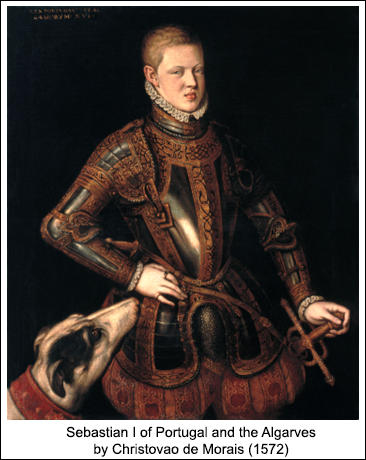
Don Sebastian, the twenty-four-year-old King of Portugal, rose early on the
morning of August 4, 1578. He was restless as they dressed him under the silken
tent in new armor, over which was applied a leather tunic to guard against the
heat of the Sun. Outside, the din of the camp was building as the army too
girded for battle. On the hills facing them, the Moroccan army was also
stirring. For Don Sebastian, the coming fight was the fruit of his labor and
the culmination of months of personal tribulation. The victory to follow would
cover him in glory he had sought all his young life.
Don Sebastian was born in Lisbon on July 20, 1554 during the reign of his
grandfather, King John III. From his first day, Sebastian's life had an ominous
quality. The death of his father, eighteen days prior to his birth, left young
Sebastian as the sole heir to the House of Aviz. His people regarded the fair,
golden-haired infant as the salvation of the throne, which might otherwise have
passed to Portugal's eternal nemesis, Spain. Phillip II, King of Spain, was a
nephew of John III and therefore a potential claimant to the Portuguese throne.
When John died in 1557, a regency was formed under Don Sebastian's great-uncle,
Cardinal Henry, until 1568, when the young man, at the age of fourteen, mounted
the throne as Sebastian I.[1]
The Portuguese empire he inherited was a sprawling network of forts linking
together trading entrepots extending throughout the Indian Ocean, from Africa
to Sumatra, and Southeast Asia, China, Japan and Brazil. Its expanse suggested
a vitality that was deceptive. Portugal was a trading empire, and her power
rested with her fleet. Poor in population (estimated at 1 million souls in
1580, at a time when France contained 16 million, Italy 13 million, and Spain 8
million), Portugal could not colonize its possessions. The empire clung to
coastal strong points, whose security relied largely on alliances with key
clans and tribes of the interior. Moreover, while the empire earned much, its
wealth benefited few. The feudal social structure endured, with the king as the
ultimate power of the land.[2]
The limits of Portuguese power were apparent in her struggle with Morocco.
Portugal, having expelled the Moors in 1249, launched the first Iberian crusade
into North Africa, capturing Ceuta in 1415. While the central reason was to
secure the Moroccan littoral against the constant threat of Barbary pirates,
Papal encouragement and the discovery of gold in the Maghreb fueled the effort.
By 1513, the Portuguese had captured every major Moroccan port on the Atlantic
coast, from Tangiers to Agadir. Spain, joining the hunt in 1494, took Melilla
and other maritime cities along Morocco's Mediterranean coast. Morocco was at
the time in one of its periods of inter-dynastic turmoil. The reigning Wattasi
sultans, ruling a kingdom that had shrunk to little more than Fez and its
environs, preferred to compromise with the invaders. Tribal rivalries and
powerful Sufi orders kept the country fragmented. And each side had its
practical concerns: The Christians enriched themselves from the sea, the
Muslims from Trans-Saharan caravan trade.[3]
It was a delicate balance of power. When in 1508 Portugal began interfering
with the caravan trade, that balance was shattered, providing the impetus for
Muslim unity. In the south, from the High Atlas Mountains, a rebellion grew as
the tribes came together under Mohammed Cheikh, a leader of the Beni Saad clan.
The Saadians, as they came to be called, installed themselves in Marrakech in
1525. By 1549, they had ousted the Wattasis and united Morocco. In the next few
years, the Saadians would turn the tide against the Portuguese, culminating in
the recapture of Agadir in 1541. Shortly thereafter, the Portuguese evacuated
most of their possessions on the Moroccan littoral, maintaining only Mazagan,
Tangiers and Ceuta.[4]
Don Sebastian grew up in the bitter aftermath of the Saadian victory and his
formative years shaped him for the Crusade. A Jesuit education and endless
drilling in the chivalrous profession of arms made their mark upon a boy
described as "impulsive, excitable and chimerical".[5] The young king fashioned
himself as a great Christian warrior.
Morocco, the old battleground, would be the beacon of that destiny. Weak and
fragmented at the time, the country remained independent through the
preoccupations of her more powerful neighbors. The Iberian states were
committed to empires in the Americas and the Indies, and the Ottomans were
locked in draining struggles in the eastern Mediterranean, the Balkans and
Persia. These conditions enabled the rise of the Saadians, and they maintained
their autonomy by playing one side against the other.[6]
A prolonged dynastic crisis provided the catalyst for foreign intervention in
Morocco and the campaign that would culminate on the plain before Ksar
el-Kebir. This began when a Saadian ruler, Al-Ghalib, designated his son,
Moulay Mohammed, as heir to the throne, rather than his eldest brother, as
tradition demanded. The sultan then attempted to liquidate his three brothers.
Evading their would-be assassins, the brothers escaped to Algeria and the
shelter of Ottoman lands. The crisis lingered as the pretenders courted
Spanish, then Ottoman support. Finally, in 1575, the oldest surviving claimant,
Abdelmalek, returned from exile with a Turkish army and conquered Fez. Moulay
Mohammed, who had by then succeeded his father as sultan, fled to the Atlas
Mountains.[7]
Abdelmalek is a remarkable if somewhat forgotten figure. He left little to
record his reign and no image of him survives. What we know of him suggests a
leader of rare quality. Fifteen at the time of his flight to Algeria, he spent
the next eighteen years in exile. That time was not wasted. Abdelmalek traveled
throughout the Mediterranean, learning the customs and languages of the people.
He came to speak Italian, Spanish and Turkish fluently. His visits to Ottoman
lands taught him an appreciation for the Turkish army and the firearms,
artillery and techniques of modern warfare. He served several periods with the
Ottoman navy, the last being in 1571 when, at the Battle of Lepanto, he was
taken prisoner. During a brief period of captivity in Oran, Abdelmalek began
demarches to foreign powers for their support to reclaim his rightful kingdom.
Despite many failures, Abdelmalek's efforts at diplomacy impressed all with
whom he came into contact, Christian and Muslim alike.[8]
Finally gaining his throne, the new sultan would have little time to
consolidate his power. The appearance of an Ottoman army in Morocco provoked
great concern in the courts of Madrid and Lisbon. For Don Sebastian, this was
his long-cherished opportunity. He immediately proposed to his uncle, Phillip
II, a joint expedition to aid Moulay Mohammed. The King of Spain, ever
circumspect, and seeing Abdelmalek as a sultan "unlike others", preferred to
watch the situation evolve.[9]
Phillip's prudence was not unfounded. While Abdelmalek admired the Turks, he
was keenly aware of their ambitions and the danger they posed. Some years
earlier, Ottoman agents had assassinated his father, Sultan Mohammed
ech-Cheikh, when he proved unmanageable. He had sought their military
assistance as a last resort and promised much for it - 500,000 ounces of gold,
the port city of Larache as an Atlantic base of operations for the Algerian
corsairs, and an alliance against Spain. However, the new Saadian sultan had no
intention of becoming an Ottoman vassal. Shortly after his victory Abdelmalek
paid off the janissaries and sent them politely back to Algeria. Not only would
Larache remain Moroccan, but Abdelmalek soon began overtures to Spain for a
defensive alliance against his Ottoman sponsors.[10]
Unfortunately, Abdelmalek's inability to corral his rival undid much of his
diplomacy. While the sultan's efforts placated Madrid, which was anxious to
return its attention to a revolt in the Netherlands, Don Sebastian was not so
easily satisfied. He continued to seek a pretext for a military campaign. This
was provided by Moulay Mohammed, who, in the months following his defeat,
continued an effective guerrilla campaign against his uncle. When the tribes
failed to rally to his cause, the deposed sultan appealed to Portugal for
assistance. In November 1577, the two struck an alliance. Don Sebastian then
turned once more to gain the support of Spain, which Phillip at last grudging
agreed to provide. Spain would contribute 50 galleys and 5,000 troops. Don
Sebastian was also authorized to recruit additional troops and purchase arms
and munitions from Hapsburg domains in Europe.[11]
Phillip, however, was far from sold on the idea. In the months that followed,
he tried to dissuade his "hotheaded" nephew from the enterprise.[12] He
informed Don Sebastian of Abdelmalek's offer of an-anti Ottoman pact, pointing
out that if the Moroccan sultan could be persuaded to make territorial
concessions, no expedition would be required. Don Sebastian replied that he
would "rather have Larache by force than Fez by negotiation".[13] The Spanish
agents sent to Morocco were duly expedited to Lisbon on their return, reporting
to the king of the difficulties of the enterprise. Portuguese nobles also tried
to dissuade their king. Equally mindful of past failures as they were lack of
an heir and the ambitions of Phillip, they urged the king to trust a
subordinate with the expedition. Their efforts were an annoyance. The fanciful
hero clung to his destiny. As the Spanish ambassador to Lisbon, Don Juan de
Silva, remarked in a letter to Phillip, "Nothing can be done. The young man
[Sebastian] pouts".[14] Phillip observed, dryly, "Well, if he succeeds, we
shall have a fine nephew, if he fails, a fine kingdom".[15]
The expedition took shape fitfully over more than a year as Don Sebastian
labored to finance and assemble the affair. While accounts vary as to the size
of the army he raised, most place the Portuguese forces and their allies at
approximately 17,000. It was a patchwork group, though common of armies of this
age. At its core were 1,500 elite Aventuros, gentlemen volunteers who
served at their own expense, making war for both glory and love of teaching the
military arts. From the finest nobility of the land Don Sebastian raised 1,100
Encubertados or heavy cavalry. Another 8,000 infantry were levied from
throughout Portugal, and 5,800 foreign troops, namely Germans and Castilians,
were recruited abroad. Rounding out this amalgamation were 600 Italian
soldiers, funded by the Papacy for an invasion of Ireland, and diverted en
route by their leader, an English adventurer named Thomas Stukeley. The pike,
sword and dagger were the predominant weapons. There were few arquebuses, owing
in part to the high cost of firearms. The artillery consisted of 36 pieces of
various caliber.[16]
The army assembled around Lisbon in late winter and spring of 1578. The chaotic
preparations did nothing to further its cohesiveness. The Italians,
ill-supplied and vexed at their predicament, raided the countryside for food.
The Germans arrived by boat from Anvers with many sick. The Portuguese
infantry, levied from the lowest classes and mainly under duress, showed little
inclination to fight. The Castilians, on the other hand, fought with everyone.
Violence between the various national contingents became so serious that Don
Sebastian was at length obliged to threaten offenders with capital punishment.
The army required time to train to meld it into a fighting force. It would get
little of that. On May 15, the day after the Germans arrived, Don Sebastian
abruptly declared preparation completed. A few more weeks of "complete disorder
and confusion" were nonetheless required before the impatient king was able to
put to sea. On June 24, 1578, the Portuguese fleet, still missing a quarter of
its strength and most of its baggage, got underway for Africa.[17]
Not everyone, however, was unprepared. While the strife among the rank and file
told of hunger and apprehension, the 1,100 wagons containing the nobles'
baggage spoke of different circumstances and greater expectations. Of the
nobility's preparations, a contemporary writer recorded, "Instead of sharpening
their weapons, they embroider their clothes. Instead of corselets, they outfit
themselves with doublets adorned with silk and gold. They load themselves with
sweets and fine foods, rather than biscuits and water. They compete in the
acquisition of vases of silver and innumerable tents, doubled in silk and
satin. They site with admiration the case of the Duke of Barcellos [a twelve
year-old boy, designated to replace his sick father], whose retinue possessed
no less than 22 pavilions. In short, each man was equipped as a king."
Such pomp required plenty of help, so a second army accompanied the troops -
"wagon drivers, with an infinite multitude of pages, lackeys, servants, Moorish
slaves, mule drivers, and women to serve, and a large multitude of women of
pleasure". The Papal Nuncio and two bishops were on hand, as were dozens of
priests to convert the land to Christianity. Even the royal poet was along to
sing the exploits of the triumphal campaign.[18] In all, this second army
amounted to at least 9,000. For the privileged, as for their king, this was no
war. It was high adventure.
Perhaps nothing was more telling of the chaotic nature of these preparations
than the near total lack of a tactical plan. From the outset, its only element
was the taking of Larache, presumably as a foothold for further operations or
leverage in bargaining concessions from the Saadians. Beyond this, no other
details were known. On July 6, in a letter to his king, Don Juan de Silva, who
had accompanied the expedition, wrote, "It's an immense misery to see the King
leave, without a single man knowing of what we are going to do, because we are
depending totally on a miracle. May God grant it!"[19] At that moment the
expedition was barely underway and already an air of deep pessimism had settled
over the army.
Discipline was lax from the start. The fleet made a hasty departure, then
meandered to Africa, stopping briefly in Lagos, then in Cadiz. Here, Don
Sebastian spent ten days naively awaiting the Spanish contingent to materialize
(Phillip had already advised his nephew that difficulties in the Netherlands
made it impossible for him to honor his commitment). His troops had other
preoccupations - namely enjoying the local hospitality. Portuguese revelry left
little energy for security, and several nights were spent at anchor in the bay
without any watch – a telling thing for a fleet of 600 sail. At length, the
local officials felt obliged to send several small craft out to guard the royal
barge. Departing Cadiz on July 7, the fleet arrived at Tangiers the next day.
There, Moulay Mohammed and his followers joined them. On July 11, the
Portuguese embarked the former sultan and his family and departed for
Arzila.[20]
Arzila, a small Moorish coastal fort 30 kilometers north of Larache, had
recently been betrayed to the Portuguese by the local caïd. Here, the
Portuguese resupplied with fresh water and waited as the remainder of the fleet
and baggage caught up. After spending two days at anchor, on July 14 the army
began to disembark. As the citadel was too small to accommodate the army, it
camped outside the walls. Twelve more days elapsed before the last ships
arrived, during which time the army consumed its precious supplies. Of this
first phase of the operation, Don Juan de Silva wrote to Phillip, "We've been
beating around the bush for eighteen days because His Majesty did not want to
wait three or four days at Lisbon in order to raise anchor with his entire
fleet; if we had left Lisbon with all our men, in four days we could have been
at Larache."[21]
Abdelmalek's preparations were, by contrast, orderly. Well before the
Portuguese set sail, he had begun to re-vitalize the Saadian army, introducing
military Turkish methods, including equipping many of his troops with firearms
and his army with European artillery and renegades to man them.[22] Informed by
spies of the Portuguese preparations, the sultan quickly determined how to meet
them. To augment his regular army, Abdelmalek sent forth the oulema to the
tribes with a call to jihad. He ordered his younger brother, Moulay
Ahmed, governor of Fez, to harass the Portuguese where they should disembark
and to move southwest to join forces with his own near Ksar el-Kebir. On July
3, as the Portuguese were celebrating at Cadiz, Abdelmalek began to move north
from Marrakech with an army of 14,000 horse, 2,000 arquebusiers, and 26 cannon.
From Fez, Moulay Ahmed's army of 22,000 horse and another 5,500 arquebusiers
prepared to join with them.[23]
At Arzila, the languorous summer days passed, with little energy given to
anything feasting, prayer and yet more quarreling. Two thousand tents crowded
the plain around the citadel, with nothing more than sentinels as protection.
Don Sebastian disdained to take further measures. The conduct of the army began
to turn comedic. One night, an Italian sentry fired on Thomas Stukeley as he
inspected the perimeter. In the ensuing panic, thousands of soldiers streamed
to the beach in an attempt to regain the boats in the harbor. Don Juan de Silva
wrote, "There was an extreme confusion, no man knew what he had to do or where
to go, to such an extent that, if there had been an enemy, he could have
brought about a terrible massacre without loss to himself".[24] On another
occasion 2,500 Moroccan horsemen raided the Portuguese camp. While the
Moroccans withdrew without causing much damage, the affair almost turned to
disaster when Don Sebastian, arriving tardily on the scene, launched a pursuit
on horseback with only a single companion at his side. Panic-stricken
Portuguese nobles chased after their king and all wound up exhausted and
empty-handed far from Arzila.[25]
Men and baggage at last assembled, on July 25 Don Sebastian abruptly called a
council of war. He proposed to change the tactical plan. Rather than continue
with the fleet south to Larache, he now proposed to divide his forces, sending
his admiral, Don Diego de Sousa, and fleet on to Larache, while he took the
army on a wide flanking movement to the interior. They would march on the
citadel at Ksar el-Kebir, which, once taken, would render Larache helpless to
an assault from land and sea. The army would then move unopposed on Larache. A
show of strength in the interior, he continued, offered other advantages. It
would show the Portuguese were not just content with taking a coastal town,
which would in turn rally more Moroccans to Moulay Mohammed's cause.
As the dozens of flatterers and royal favorites looked on, the few men with any
military experience and knowledge of the country sat in stony silence.
Cautiously, one by one, they raised their voices against the king's plan. They
pointed out that their principal arm – the fleet - would be negated, that the
army was too poor in cavalry vis-à-vis the enemy, the baggage and
non-combatants would reduce the mobility of the army, and that the march would
be conducted over rough terrain and in scorching heat. All their arguments fell
on deaf royal ears.[26] Don Sebastian's vision called for a decisive land
battle, and victory was a foregone conclusion. The king dismissed his
adversaries as he had other obstacles. He believed the Moroccan forces were no
greater in number to his own. He would continue in this belief, ignoring in the
coming days three intelligence reports delivered by travelers from the south –
all of which confirmed Abdelmalek's army at between 50,000 and 70,000, and
waiting patiently along his intended line of advance. [27] Don Sebastian
proposed July 29 as the date of departure.
Unknown to the bungling Portuguese, as they dithered in Arzila, their fortunes
were on the rise. Shortly after departing with his army from Marrakech,
Abdelmalek fell violently ill. Rumor circulated that he had been poisoned.
Still others said he'd consumed spoiled milk. Whatever the cause, the sultan
fell into fits of vomiting that so weakened him that he had to make much of the
march in a litter. Despite his suffering, Abdelmalek made one more effort at
diplomacy as he prepared for the worst. On July 22, he wrote a letter to Don
Sebastian, asking, "…what reason pushes you to pursue against us a war so
unjust, especially when God Almighty seems to abhor these things without
reason?" After reminding the Portuguese King of his alliance with the Turkish
Sultan, Abdelmalek concluded with an offer of "thirteen league of terrain, from
the sea to firm ground, so that you may build such fortresses as you wish, near
the sea, that will provide more than sufficient plowing for the necessary
provisions…". He also offered Don Sebastian a maritime city of his choosing.
Don Sebastian dismissed this offer as a sign of weakness.[28]
These aimless days at Arzila greatly taxed not only the provisions, but the
spirit of the Christian forces as well. The morale of the army was in fact
reaching a nadir on the eve of the march. In his last letter to Phillip, Don
Juan de Silva wrote, "I cannot depict in a complete manner to Your Majesty the
difficulties that assail us. But one must consider how few we are for such an
adventure; the soldiers are inexperienced, undisciplined, poorly commanded, and
without any leader but the King, whom, by his excessive temerity took from the
army any courage it might have had and filled it with fear. Finally, not an
officer ventures to contradict the King, and all are certain that he leads them
to a certain death."[29]
The Portuguese army finally lumbered forth from Arzila on July 29. It bogged
down almost immediately. The immense baggage train staggered along the rocky,
undulating terrain. Each dry riverbed became a major obstacle. Men dressed in
wool and heavy armor wilted in the 90-degree heat. Even the nobles and their
king, riding in their gilded carriages, must have shared in the general
discomfort. Most urgent was the lack of provisions. As the march to Larache was
expected to take only six days, rations were only issued for this duration.
Most of the provisions remained with the fleet. The troops each received 9
'arratis' of biscuit, 1 ½ pounds of cheese, and 3 'quartilhos' of wine (for a
daily ration of 690 grams of bread, 115 grams of cheese and ¼ liter of wine) –
a quantity completely insufficient for the rigors of the march. Many soldiers
consumed half their allotted rations on that first day. By evening of the 30th
the condition of the army was so serious that Don Sebastian called a council of
war to determine what might be done. Much to the astonishment of all, the king
reluctantly accepted the council's advice to return to Arzila.[30] A march of
barely ten kilometers sufficed to defeat Don Sebastian's mighty invasion.
Seemingly, fate would intervene. A detachment of cavalry sent to advise the
fleet of the army's return found instead an empty harbor. Don Diego de Sousa
had faithfully executed his King's order to sail to Larache. Instead, the
Portuguese found Spanish Captain Francisco Aldaña and a contingent of 500
Castilians who had just arrived to join the army. Expecting to be equipped on
site, they arrived without arms. The combat power they added was offset by the
supply problems they compounded. Their more immediate impact was to restore the
royal morale. Joining the army that evening, the appearance of these
reinforcements and the departure of the fleet were sufficient to induce Don
Sebastian to stay the course.[31] The army would continue its march to Ksar
el-Kebir.
Abdelmalek and Moulay Ahmed and an army of 50,000 troops awaited them at Suk
el-Khamis, 10 kilometers south of Ksar el-Kebir. The sultan's condition had
steadily worsened, leaving him completely bed-ridden, yet he continued to
command the army. Abdelmalek still sought to avoid a major engagement, but
would ensure its success if such was required. So, the Moroccans pursued a
'scorched earth' tactic, blocking wells and fountains, emptying granaries, and
destroying crops in the path of the Portuguese.[32] This tactic soon achieved
its purpose. After two more days march, on August 2, the Portuguese army had
nearly reached the limits of its endurance. That evening, another council of
war yielded another change of plans. It was decided the army would turn west,
short of Ksar el-Kebir, cross the Loukkos River at the ford of Mechara
en-Nedjma, and follow the river to Larache.
It was a terrible mistake. Given the army's dire circumstances, an immediate
march on Larache was the only sensible decision. However, descending the
highlands and crossing the Loukkos surrendered the protection the river might
have offered and exposed the Portuguese to attack. Furthermore, to reach the
Loukkos, the army had to cross one of its tributaries, the Makhazen – as much
as 50 meters wide, with steep banks and treacherous tidal waters. South of the
Loukkos, the Portuguese lines of retreat would be cut off by not one, but two
major obstacles.
The next day, August 3, the Portuguese reached the Makhazen River. Finding the
bridge they had intended to use occupied by the enemy, the army crossed the
river at a ford five kilometers down stream. Don Sebastian ordered camp made
south of the crossing site, in a vast, denuded cul-de-sac that was the
confluence of the Makhazen and Loukkos rivers. The king selected the terrain
for "beautiful cavalry charges and high feats of arms." His troops were hardly
capable of either. The army had covered less than 40 kilometers since leaving
Arzila, and in its wake it left a trail strewn with the both the superfluous
and the essential - armor, baggage, and many of the cannon were jettisoned.
Even as they made camp, what artillery that remained to them was stranded on
the north bank of the river. The waters of the Makhazen rose behind them and
the ford across the Loukkos was yet five kilometers distant. When Abdelmalek
learned that Don Sebastian had abandoned his strategic position for a camp on
the open plain, he was stunned. "Then, the Portuguese King is truly lost!" he
exclaimed.[33] Judging all to be in his favor, the sultan moved his army north
to block the approach to the Mechara en-Nedjma ford.
That evening, the Portuguese held another grim council of war. The army's
predicament was apparent to even Don Sebastian. The Moroccans, now camped in
full view, were vastly superior in number. Their advanced was barred, their
line of retreat was precarious, and the troops were hanging on physically. Many
had eaten little or nothing in days. The discussion was, for once, frank. The
decision boiled down to whether to hazard a battle or not. Many counseled
defense, digging in with the river guarding their flanks, and relying on the
infantry and the pike against the enemy's superiority in cavalry. Still others,
Captain Aldaña foremost, argued the army could not hold out long in its current
state and must force the issue. They pressed their king to attack at dawn,
hoping to catch the enemy unprepared. Finally, Moulay Mohammed spoke. He
advised Don Sebastian to hold an attack until later in the day. Spies reported
that his uncle was near death, and the loss of the sultan at such an hour might
well undermine the Saadian army. Failing this good fortune, he continued, a
battle at a later hour offered the possibility of a night withdrawal, should
such be necessary. Don Sebastian, never prone to take advice, was in his
quandary not about to take it from such a source. The king ordered an attack at
first light.[34]
As the Portuguese labored across the Makhazen, the sultan arrayed his forces in
a broad crescent before them. The terrain of the Loukkos valley did indeed
favor the horse, as Don Sebastian remarked. The crescent formation, which the
sultan had learned from the Turks, offered the Moroccan cavalry the ability to
outflank and envelop the Christians before they could launch a frontal assault.
In the center and in front of the Moslem formation were the sultan's 34 cannon,
deployed on a rise and camouflaged with branches. Behind the guns, drawn up
into three ranks, was the infantry. The best troops occupied the first two
ranks, 3,000 Andalusians, followed by an equal number of renegades of mainly
European blood, and, finally, 5,000 Moorish and Arab troops. At each horn of
the crescent were detachments of 5,000 regular cavalry, including 3,000 mounted
arquebusiers. The remainder of the cavalry, as many as 25,000 strong, commanded
by Moulay Ahmed, was held in reserve behind the infantry, ready to strike in
any direction.[35]
The troops in place, that afternoon the sultan rose from his litter to speak to
his army. It was the first they had seen of him in three weeks. On a
magnificent white charger, Abdelmalek rode beneath the royal umbrella of
crimson and gold, surrounded by his personal guard of 200, and preceded by
dozens of trumpeters and drummers. Before him horsemen carried five sacred
green banners of Islam. The pageantry only amplified the poignancy of the
scene. As Abdelmalek drew near, the troops knew they were looking at a dying
man. While the sultan's splendid robes concealed the strap that held him to his
mount, nothing could camouflage his ashen, withered face. "Oppose him [the
Portuguese] with your valor," he exhorted them in a steady voice, "for you
fight in the most noble enterprise: That which prevents injury to your
families, upholds liberty, conserves life, acquires honor, and, which, living
or dying as it may be, leads to Paradise!" The settling evening, still but for
the occasional neighing of horses, now erupted in a chorus of "Allah Akbar!
Yahya l-Malik! Yahya Islam!" [36]
The morning of August 4, 1578 found neither side in a hurry to fight. The
Moroccans watched and waited as the Portuguese hauled their remaining artillery
across the Makhazen and deployed their forces. When at last Don Sebastian
emerged from his tent, the Sun was already high in the cloudless sky. The king
mounted the black charger his pages had held in readiness since first light. He
announced that he would give the order to attack, adding that the army was to
respond only to his personal command. Don Sebastian then joined nobles. The
bishops of Coimbra and Oporto led them in a solemn benediction and they thanked
God for the coming victory. Along the battle lines, dozens of priests
circulated among pensive veterans and trembling recruits, offering a more
humble appeal. At 10:00 a.m., the Portuguese army began to advance toward the
Loukkos and the waiting Moroccan army.[37]
Tied to the non-combatants and poor in cavalry, the Portuguese army deployed
for the attack as a vast moving square. What little artillery remained to the
army (perhaps as few as six pieces!) was deployed forward where it might have
some affect on the initial charge. Next came the advanced guard, consisting of
the few reliable troops - the Italian and the Castilian regiments on the left,
the Aventuros in the center, and the Germans on the right. Though the
square depended on the mutual support of the pike and arquebus, the troops at
this critical point were almost entirely pikers. The few groups of arquebusiers
guarded the flanks of each regiment. The cavalry was deployed forward on both
flanks of the army, the main force of some 1,000 horse under Don Sebastian on
the left. On the right Don Duarte de Meneses and the Duke of Aviero commanded
detachments of 500 each, with a third force of 600 Moroccan horse and 200
arquebusiers under Moulay Mohammed. The main body followed – five regiments of
troops that formed the left, right and rear of the square. Each flank was
secured by a regiment of Portuguese infantry. These troops were shielded from
cavalry charges by two long lines of wagons, reinforced by arquebusiers,
deployed in column on both sides of the square. The rear guard was composed of
three regiments, two of mainly inexperienced Aventuros flanking a center
regiment of arquebusiers. Inside the square churned the baggage train - a
chaotic thong of men, beasts and wagons that must have covered several acres.
The 500 unarmed Castilians were somewhere among them.[38] Half its strength and
most of its arquebusiers were assigned to a purely defensive role. The army
could spare no reserves.
An anxious hour's march brought the armies into range and at 11 a.m. the battle
began with a salvo by the Moroccan artillery. Moorish horsemen suddenly
appeared from the folds in the terrain, ringing the Portuguese. They had
marched into the heart of the enemy crescent. Unperturbed, Don Sebastian
signaled the advanced guard to attack. It was the only order he would give the
army. Cries of "Aviz e Christo" and "Bismillah" filled the
air as the Christian and Moslem infantry surged past their artillery and
towards one another. The Aventuros' impetuous reputation did not fail
their army, and they charged the Andalusians with gusto. The Moslem
arquebusiers volleyed and buckled their lines, but the slowness of reloading
allowed the Portuguese to close. The pike then did its work, driving the Moslem
front ranks back and throwing their center into confusion.[39]
Victory, for a moment, seemed within reach. Then, Pedro de Lopes, the Sergeant
Major of the Aventuros, gave the fatal command, "Stop, stop! Turn
back!" The charge of the advanced guard opened a gap between these regiments
and the main body, into which poured the Moorish cavalry. Fearing himself
surrounded and cut off from supporting regiments, Lopes called a halt just as
his men were about to take the Moslem guns. The Italian, Castilian and German
contingents, keying on the center, too wavered, then stopped. In an instant,
the momentum of the attack, and with it the advantage of the pike, was lost.
The renegades and Moorish reserves filled the ranks of the remaining
Andalusians. The Christian advanced guard, surrounded and greatly outnumbered,
gave ground, and their artillery was overrun.[40]
Seeing the extremity of the advanced guard, the Duke of Aviero launched a bold
attack against the Moroccan right. Marshalling the contingents of Don Duarte de
Meneses and Moulay Mohammed, the Duke led the cavalry charge that drove the
Moorish horse facing them off the field. Many did not stop until they reach Fez
- over 100 kilometers away. Rallying his men, Aviero took them headlong into
the exposed left flank of the Moroccan main body. The Moslem infantry, having
only regrouped from the initial Christian charge, was thrown into disorder and
two of the five green standards of the sultan fell into their hands. "Believe
me," wrote Abdelmalek's Jewish physician, "we thought to lose all." Yet, once
again, momentum was lost. Christian attacks were uncoordinated and there were
no reserves to exploit success. Aviero's cavalry became scattered and before he
could regroup them, Moorish cavalry reserves counterattacked. Those Portuguese
cavalrymen who were not surrounded and overwhelmed were pursued pell-mell back
into their own lines, trampling and sowing chaos amongst the exhausted German
infantry.
The same scene was played out on the left flank. As Aviero's cavalry charge was
being beaten back, the Portuguese horse on the left flank attacked the Moorish
cavalry facing them. Once again, the Portuguese' initial success was lost when
they failed to regroup in time to confront a counterattack by Moslem reserves.
Once again, they were chased back into their own lines, where this time they
trampled the Italians and Castilian regiments.[41] With this action, the
Portuguese cavalry was effectively destroyed. The initiative now passed
completely to the Moroccans.
Don Sebastian's example, rather than his generalship, would have to provide the
margin of victory. This day, he was to prove that physical courage was not one
of his many defects. At the outset of the fighting, the king left the cavalry
of the left flank to join the fight of the advanced guard. From that moment,
the Portuguese army was without direction, as its commander abdicated to the
fray. If he did little to ensure the success of the army, as the tide turned,
Don Sebastian fought like a lion to save it from annihilation. The young king
battled with fanatical courage, rushing here and there, bringing reinforcements
and leading cavalry charges in a futile attempt to hold the square together.
Wounded in the arm, with three horses shot from beneath him, Don Sebastian was
relentless. It was said that he killed as many of the enemy as any man in the
army that day.[42]
The Moorish cavalry had now completely encircled the Christian formation,
penetrating the line of wagons and attacking the hapless Portuguese conscripts.
Some fought for their lives, others fled to hide among the noncombatants. Many
threw down their arms and begged for mercy, only to be cleft by the scimitar.
Panic built as the square pressed in on itself. There was no place to flee for
man or beast. An eyewitness wrote, "This Army, which did contain 3 miles in
compass, was in an instant consumed by the sword, and did so restrain itself
through fear, that a small room might contain it."[43]
Yet, at this desperate hour, a glimmer of hope suddenly shone. A nobleman
fought his way to the side of his king, crying, "Courage, courage! The sultan
is dead!" It was true. Abdelmalek, his fury aroused at seeing his troops take
flight before Aviero's attack, struggled from his litter in an attempt to stem
the tide. The sultan's last strength gave way as he mounted his charger and he
collapsed into the arms of his attendants. Thirty minutes later, Abdelmalek was
dead. Fortunately, for the Moroccans, the sultan had foreseen such a
possibility. According to prior instructions, the kingdom and command passed
seamlessly to Moulay Ahmed. The sultan's death was to be concealed until after
the battle was won. Nevertheless, the news of Abdelmalek's death did leak to
both armies, though too late to influence the outcome.
The Portuguese army, hotly engaged on all sides, began to break up. "Not one of
us will escape today!" Captain Aldaña cried. The van of the advanced guard, its
flanks crushed, fought on gallantly but with failing strength. By this time,
they had fought for hours with no chance to disengage. Most of their pikes had
been lost or broken and their few firearms could not hold the enemy at bay.
Moslem numbers had already turned the tide, now their materiel superiority made
itself cruelly felt. The mounted arquebusiers came forth in waves, closing to
point-blank range, discharging their weapons, then wheeling back to reload. The
Italians and Castilians lunged at their tormentors with daggers, killing
hundreds, yet still the Moslems came. The main body, now a huddled mass of man,
beast and baggage, raked by gunfire from all angles, was paralyzed with fear.
The rear guard dissolved completely. An attempted reinforcement by Don
Sebastian at the head of 500 troops arrived too late to restore the situation.
The battle was turning into a slaughter from which few had the opportunity to
flee. Moulay Mohammed was one of the fortunate. Never enthralled with Don
Sebastian's plan, he was quick to lose heart when the tide turned. After the
Moorish cavalry overwhelmed Aviero's and his own, Moulay Mohammed and a handful
of followers attempted to save themselves by fleeing back across the Makhazen,
presumably over the same ford the Portuguese army had used the day before.
However, the tides were high at mid-day and the former sultan did not know how
to swim. Thrown from his mount, Moulay Mohammed drowned in the swift currents.
The end was near. One by one, the knots of men that once were regiments
succumbed to the incessant onslaught. The Aventuros, then the
Italians, then Castilians were in turn overwhelmed. Somewhere in the melee a
few of the Germans and a small group of Aviero's cavalry remained, including
the Duke, Don Sebastian, and Don Duarte de Meneses. The nobles pleaded with
their king to save himself. "What resources is left to us?" one of them asked.
"Heaven, if we deserve it by our deeds!" the king replied, and he charged once
more into the fray.[44] Within minutes he was dead. The coup de grace came
cruelly and from an unexpected quarter. A swarm of Arab irregulars who had
lingered on the periphery of the battle, impatient to join the pillage that was
now beginning, intervened to hasten the end. They fell on the exhausted,
blood-soaked survivors and with their crude instruments clubbed and hacked them
down. Among the last to fall were the Duke of Aviero and Thomas Stukeley. It
was 5 p.m. and the battle was over. For the thousands of non-combatants, the
horror was only beginning.
The Battle of the Three Kings, as coined by European chroniclers for the fallen
monarchs, required no dramatics for the Portuguese. In a single afternoon the
flower of that nation was wiped out. Among the 8,000 dead lay Portugal's
military elite. Scarcely a noble family was untouched by the tragedy. Of 26,000
souls, fewer than 100 escaped the carnage and infiltrated back to Ceuta or
Tangiers. It was a devastating human toll that would have been far worse had
the Moroccans subscribed to the Turkish method of dealing with prisoners. As it
was, ransoming captives had long been a part of the economic culture of the
Barbary. Many of the 18,000 prisoners, among them Don Juan de Silva and the
Duke of Barcellos, would be repatriated. Moroccan casualties amounted to
probably 5,000 dead and many more wounded.[45] None of their losses was more
tragic than that of Abdelmalek, whose heroic death at 35 deprived his people of
the capable leadership they had so often lacked.
For Portugal, the consequences of the defeat were immediate and far-reaching.
Not only was her era as a great power abruptly ended, but her very survival was
imperiled. A contemporary writer recorded from Lisbon, "You cannot imagine how
great were the lamentations, the despair and the grief, not only in this city,
but in all the land. The men went about as if dazed. The wailing of the women
was so loud that it can be compared with that which rose after the taking of
Antwerp. It is a woeful matter to lose in one day the King, their husbands,
their sons…But what is even more terrible is that this kingdom must now fall
under Spanish rule, which they can brook the least of all."[46]
These words were prophetic. The crown passed back to the aged Cardinal Henry,
who died in 1580 without an heir. The unhappy country, despoiled of wealth,
leaderless and without an army, was at the mercy of Spain. That year, Philip II
asserted his claim, which the Duke of Alba and a Spanish army enforced.
Portugal then passed to Spain in a troubled marriage that would last until
1640.
Like Don Quixote and his windmill, Don Sebastian would find an improbable
measure of the immortality in defeat. From the countryside of occupied Portugal
a messianic cult of Sebastianism arose among those who preferred to believe the
king had not died and would one day return to liberate the country from Spain.
While the rebellions it inspired failed, the legacy lives on. Even today,
Sebastianism survives as an idea of nostalgia for the unattainable.
For Morocco, the idea of the victory was more enduring than its result.
Problems of succession and tribal rivalries prevented the Saadians from
translating this success into an enduring dynasty. Moulay Ahmed, known to
history as "El Mansour" (The Victorious) would be the last of the Saadian
sultans. In the centuries that followed, Morocco's struggle against foreign
domination would continue. While the fight was not always successful, it was
from this trial that Moroccans forged a national identity.
Show Footnotes and
Bibliography
Endnotes
[1]. Pierre Berthier. La Bataille de L'Oued el-Makhazen (Paris: Centre
National de la Recherche Scientifique, 1985), p. 45.
[2]. Ibid, p. 25.
[3]. Dahiru Yahya. Morocco in the 16th Century: Problems and Patterns in Foreign
Policy (New Jersey: Humanities Press, 1981), pp. 2-3.
[4]. Berthier, p. 22.
[5]. Ibid, p. 49.
[6]. Yahya, p. xiii
[7]. Larbi Essakali. Le Memorial du Maroc, Volume 3 (Paris: Nord
Organization, 1982), pp. 148-159.
[8]. Ibid, pp. 164-5.
[9]. Larbi, p. 155.
[10]. Younes Nekrouf. La Bataille des Trois Rois (Paris: Editions Albin
Michel, 1984), p. 101.
[11]. Ibid, p. 138.
[12]. Ibid, p. 151.
[13]. Ibid, p. 157.
[14]. Ibid, p. 177.
[15]. Marjorie Bowen. Sundry Great Gentlemen (New York: Books for
Libraries Press, 1928), p. 142.
[16]. Berthier, p. 119.
[17]. Nekrouf, pp. 180-1.
[18]. Ibid, p. 180.
[19]. Berthier, p. 108.
[20]. Ibid, p. 108.
[21]. Ibid, p. 109.
[22]. Ibid, p. 94.
[23]. Nekrouf, p. 190.
[24]. Berthier, p. 111.
[25]. Nekrouf, p. 187.
[26]. Berthier, p. 112.
[27]. Nekrouf, p. 193.
[28]. Ibid, p. 115.
[29]. Ibid, pp. 119-120.
[30]. Ibid, p. 118.
[31]. Nekrouf, pp. 196-197.
[32]. Berthier, p. 138.
[33]. Bowen, p. 155.
[34]. E.W. Bovill. The Battle of Alcazar (London: Batchwork Press,
1952), p. 116.
[35]. Ibid, p. 122-123.
[36]. Nekrouf, p. 207-208.
[37]. Bowen, p. 158.
[38]. Berthier, pp. 118-120.
[39]. Bovill, pp. 127-128.
[40]. Bowen, pp. 159-160.
[41]. Bovill, pp. 130-132.
[42]. Ibid, p. 136.
[43]. Bovill, p. 138.
[44]. Bowen, pp. 160-162
[45]. Bovill, pp. 137-143.
[46]. Ibid, p. 145.
Bibliography
Berthier, Pierre. La Bataille de L'Oued el-Makhazen , Paris: Centre
National de la Recherche Scientifique, 1985.
Blauer, Ettagale and Jason Lauré. Morocco . Chicago: Children's Press,
1999.
Bovill, E.W. The Battle of Alcazar , London: Batchwork Press, 1952.
Bowen, Marjorie. Sundry Great Gentlemen , New York: Books for Libraries
Press, 1928.
Cross, Esther and Wilber. Portugal , Chicago: Children's Press, 1986.
Dupuy, Ernest and Trevor. The Encyclopedia of Military History . New
York: Harper and Row Publishers, 1977.
Essakali, Larbi. Le Memorial du Maroc, Volume 3 , Paris: Nord
Organization, 1982.
Everyman Guides: Morocco , London: David Campbell Publishers, 1994.
Livermore, H. L. Portugal and the Portuguese World , Milwaukee: The
Bruce Publishing Company, 1957.
Nekrouf, Younes. La Bataille des Trois Rois , Paris: Editions Albin
Michel, 1984.
Pattee, Richard. Fables de La Memoire: La Glorieuse Bataille des Trois Rois
, Paris: Editions du Seuil, 1992.
Seward, Paul. Cultures of the World: Morocco , New York: Marshall
Cavendish, 1995.
Yahya, Dahiru. Morocco in the 16th Century: Problems and Patterns in Foreign
Policy , New Jersey: Humanities Press, 1981.
For further reading:
French linguists will find no better material than Pierre Berthier's
outstanding book, "La Bataille de L'Oued el-Makhazen".
I gratefully acknowledge:
The Middle East and Africa Reading Room, United States Library of Congress, Mr.
Kamal Lakhdar, and Mr. Robin Harcourt Williams, Hatfield House, for their
assistance with my research.
Copyright © 2008 Comer Plummer
Written by Comer Plummer. If you have questions or comments on this article,
please contact Comer Plummer at:
comer_plummer@hotmail.com.
About the author:
Comer Plummer is a retired US Army Officer. He served from 1983 to 2004 as both an
armor officer and Middle East/Africa Foreign Area Officer. He is currently
employed as a DoD civilian and living in Maryland with his wife
and son.
Published online: 06/14/2008.
* Views expressed by contributors are their own and do not necessarily represent
those of MHO.
|