The dominance of Milanese plate armor in the fifteenth century was rooted in a highly integrated, proto-industrial manufacturing ecosystem rather than individualized craftsmanship. Production relied on a complex supply chain, beginning with the extraction of pure Alpine siderite ore and ending in urban workshops powered by the Navigli canal network. To meet the massive military demands of the Italian mercenary system, a specialized assembly line was established to maximize volume under strict guild oversight. Metallurgical and geometric innovations further distinguished the final product. The combination of variable plate thickness, thermal quenching, and sweeping deflecting curves created a highly resilient defensive shell, rendering shields obsolete. Ultimately, the development of Milanese steel represented a fundamental shift that redefined both Renaissance battlefield survival and early industrial organization.
Morocco, August 4, 1578.
Sir Thomas Stukeley, presumptive Marquis of Leinster, squinted into the sun. It was plain as a pikestaff that neither side was anxious to get under way. The day was several hours on, and the heat was already upon them. The chill of the past night, spent huddled around one of the rare campfires, seemed remote now.
He tugged at his breast plate and looked out over the arid plain. It was poor land for anything, even dying. Was this the end? What an irony. He, who had evaded death alongside some of the great captains of the day, Somerset at Pinkie, Philibert at Saint Quentin, Don John at Lepanto, and a dozen lesser butchers at battlefields in Normandy, Flanders, Alsace, Scotland, and on the Rhine; he, who had courted and trumped monarchs, princes, and popes, drowning in the clutches of a lunatic boy-king!
They had tried one last time to prevail upon the king. That morning, as the last of the artillery and baggage was coming across the river, the council had met. The sounds of the enemy—the pounding of drums and cymbals, the blurting horns—carried into their midst. The tension was acute. Once more, they tried to convince Sebastian to delay the attack until the afternoon. The Moroccan battle formation was now apparent, as were their numbers. They were many thousands, and there would be no bypassing them on the way to the Loukkos. Moulay Mohammad pleaded with the king to wait: The Moroccan sultan, Abdelmalek, was living his last hours!
On Tuesday morning, April 12, Judar Pasha woke well before dawn.[2] Like many men, he had passed a fitful night. Outside, he could hear the sound of the camp breaking up. Crabby animals. Anxious men. The air in the tent was heavy. There was a shaft of lighter darkness from the flap. Otherwise, the blackness was absolute.
Judar’s eyes refused to adjust. He began to grope, for his chain mail vest, for his cloak. After a few moments, he managed to locate his boots, rearranged by his nocturnal perambulations. As Judar emerged from his tent, his servants moved in to begin packing up.
He waved away the proffered tea. In a moment, he gestured. Taking several steps toward the river, Judar relieved himself while scanning the emerging landscape.
As we enter 2014, the 700th-year anniversary of the Battle of Bannockburn and the year of the referendum on Scottish independence from the United Kingdom, it may be appropriate to look back at other battles fought between the Scots and the English.
Throughout the centuries, the two nations have fought several epic battles – some well-known like Bannockburn, Flodden, and Cullodden – and others more obscure to the general public, but no less fascinating from a historical point of view.
One such forgotten battle was the Battle of Pinkie Cleugh, fought close to the town of Musselburgh, just east of Edinburgh, in 1547.
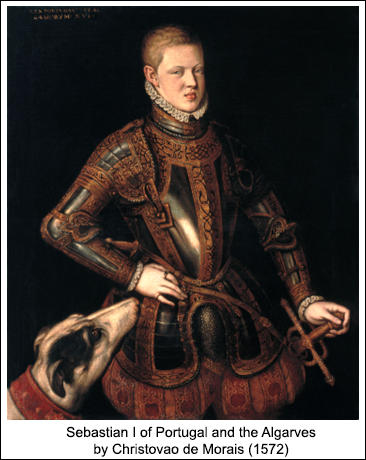
It was a pleasant day of early spring in Lisbon and King Sebastian I of Portugal and the Algarve was making the most of it, bounding about the gardens of the Ribeira Palace. His elfish form disappeared momentarily behind the hedges and then into the shadows of the King's Tower before popping out again, diminutive rapier in hand, the shock of copper hair tussled. Normally, the sights and sounds of the Tagus River and nearby shipyard would have been the boy's primary diversions, but this day was different. Today, there were a thousand imaginary enemies at hand, and the King was determined to slay them all.
It was in Constantinople, perhaps in 1558, or even years later, that on a certain
day a weathered basket containing the rotten head of Mohammed ash-Shaykh toppled
from the ancient Walls of Theodosius. It had hung there for a long time. Just how
long, no one quite remembered. It tumbled into the refuse that collected along the
base, a forgotten memento, uninteresting to even the wild dogs that scavenged there.
Such a spectacle was, for the era, both callous and insipid. Eventually, it would
become a dubious distinction for a Moroccan sovereign. In the final analysis, it
might be described as a nadir that underscored an audacious life.
Martin Luther's Ninety Five Theses on the Power and Efficacy of Indulgences was
nailed to the castle church in Wittenberg, in now modern day Germany, on October
31, 1517. This document was a protest that strongly criticized the practice of selling
indulgences of the Roman Catholic Church, known here after as the Church. The document
was a challenge to church authority that set forth events that permanently changed
the religious, political, and social factors of central Europe, and led to a series
of wars using the pretext of faith, and the role of the Church in the political
structure of Western Europe.
After a short foray in July of 710 AD, Muslim forces from North Africa invaded
the Christian Iberian Peninsula (modern day Spain and Portugal) in the spring
of 711, and within two years, with the exception of the extreme northwestern
portion of the peninsula, had successfully overpowered and conquered the
Visigothic Christian realms of Iberia.[1] Not only did it take the Frankish
forces under Charles Martel to stop the Muslim horde at the battle of Poitiers
in 732 from further intrusions into Western Europe, it would take nearly eight
centuries for the Iberian Christians to re-take the peninsula from the Muslims.
Cairo residents call it the Qal'at al-Jabal, the Fortress on the Mountain, or just al-Qal'ah, the Fortress. The rest of the world simply calls it
“The Citadel.” For nearly a millennium it has stood as a silent sentinel, residence, and symbol of power.
Standing on its battlements, and looking westwards provides a view of over 4500 years of architectural marvels from the mosque of Sultan Hasan,
just below to the Pyramids of Giza across the Nile. From atop this fortress the awesome sweep of history is a vivid reality. It is a
view that must have given even the sultans who ruled from here, cause to reflect.
Watching over Cairo from a spur of limestone detached from its parent Moqattam Hills by quarrying, the Citadel is among the world’s
great monuments to medieval warfare, as well as one of the Egyptian capital’s most highly visible landmark along its eastern skyline.

 Morocco, August 4, 1578.
Sir Thomas Stukeley, presumptive Marquis of Leinster, squinted into the sun. It was plain as a pikestaff that neither side was anxious to get under way. The day was several hours on, and the heat was already upon them. The chill of the past night, spent huddled around one of the rare campfires, seemed remote now.
He tugged at his breast plate and looked out over the arid plain. It was poor land for anything, even dying. Was this the end? What an irony. He, who had evaded death alongside some of the great captains of the day, Somerset at Pinkie, Philibert at Saint Quentin, Don John at Lepanto, and a dozen lesser butchers at battlefields in Normandy, Flanders, Alsace, Scotland, and on the Rhine; he, who had courted and trumped monarchs, princes, and popes, drowning in the clutches of a lunatic boy-king!
They had tried one last time to prevail upon the king. That morning, as the last of the artillery and baggage was coming across the river, the council had met. The sounds of the enemy—the pounding of drums and cymbals, the blurting horns—carried into their midst. The tension was acute. Once more, they tried to convince Sebastian to delay the attack until the afternoon. The Moroccan battle formation was now apparent, as were their numbers. They were many thousands, and there would be no bypassing them on the way to the Loukkos. Moulay Mohammad pleaded with the king to wait: The Moroccan sultan, Abdelmalek, was living his last hours!
Morocco, August 4, 1578.
Sir Thomas Stukeley, presumptive Marquis of Leinster, squinted into the sun. It was plain as a pikestaff that neither side was anxious to get under way. The day was several hours on, and the heat was already upon them. The chill of the past night, spent huddled around one of the rare campfires, seemed remote now.
He tugged at his breast plate and looked out over the arid plain. It was poor land for anything, even dying. Was this the end? What an irony. He, who had evaded death alongside some of the great captains of the day, Somerset at Pinkie, Philibert at Saint Quentin, Don John at Lepanto, and a dozen lesser butchers at battlefields in Normandy, Flanders, Alsace, Scotland, and on the Rhine; he, who had courted and trumped monarchs, princes, and popes, drowning in the clutches of a lunatic boy-king!
They had tried one last time to prevail upon the king. That morning, as the last of the artillery and baggage was coming across the river, the council had met. The sounds of the enemy—the pounding of drums and cymbals, the blurting horns—carried into their midst. The tension was acute. Once more, they tried to convince Sebastian to delay the attack until the afternoon. The Moroccan battle formation was now apparent, as were their numbers. They were many thousands, and there would be no bypassing them on the way to the Loukkos. Moulay Mohammad pleaded with the king to wait: The Moroccan sultan, Abdelmalek, was living his last hours!