The Battle of Hobkirk’s Hill, 1781: Tactical and Strategic Study
By John PezzolaThe Battle of Hobkirk's Hill was fought on April 25, 1781, not far from Camden, South Carolina. Camden was the main operational post for the British establishment of backcountry fortifications. Camden also guarded a crucial network of roads leading to Charleston where supplies and communications would be brought into the interior from coastal ports. If Camden were abandoned, posts such as Augusta, Ninety Six, and other posts would fall. Lord Francis Rawdon, now commanded Crown forces in the interior since his predecessor Lord Charles Cornwallis had marched to Virginia in order to re-supply and refit his army. Rawdon decided that he must destroy the American army in the field. The American Army, under the command of Major – General Nathanael Greene, was poised on a ridge known as Hobkirk's Hill. A British force led by Rawdon launched an attack in order to drive Greene’s forces from their position and possibly destroy them. Following heavy fighting between both Greene’s and Rawdon’s forces, Greene retreated, leaving Rawdon forces in command of the hill. Despite his tactical victory, Rawdon found it necessary to abandon Camden a few weeks later and withdrew his force to nearby Charleston, South Carolina. Despite the loss, the Battle of Hobkirk’s Hill was a strategic victory for American forces since it forced the British to abandon their string of outposts in the South Carolina backcountry. In describing the engagement that took place at Hobkirk’s Hill, the tactics utilized by both sides will be explored to further enhance the understanding of the contest fought between Greene and Rawdon.
Strategy in the Southern Theater
Major General Nathanael Greene decided to base his strategy on the fact that the Crown forces in the Southern theater did not necessarily have to be defeated in battle. If they lost their communications and lines of supplies they could be chased out of the Southern colonies. Victory in battle would have been preferred by Greene, but following the engagement at Guilford Courthouse back in March of 15, 1781, Cornwallis forces were in need of being supplied and required reinforcements. “With a third of my army sick and wounded . . . the remainder without shoes, and worn down with fatigue, I thought it was time to look for some place of rest and refitment.”[1] Cornwallis’s army was in a dangerous position. His army was almost 150 miles away from their interior post of Camden and about 200 miles away from Wilmington, North Carolina on the Atlantic coast. For this reason, Greene decided to focus his effort on defeating Cornwallis. His men were lacking basic necessities and didn’t even have tents to shelter them from the March weather.
Greene was determined to bring the war into South Carolina. As Cornwallis moved further away from the interior, the only chance the British had of holding the inner part of South Carolina rested on two posts, Camden and Ninety Six as well as the outpost of Augusta, Georgia. Early in April, Greene dispatched Lieutenant Colonel “Light Horse Harry” Lee’s Legion, with Colonel Francis Marion’s contingent of Partisans in order to disrupt the vital communications link between Camden and Charleston, South Carolina. Among the partisans General Thomas Sumter, and his force, were tasked with controlling the country between Camden and Ninety Six[2]. General Andrew Pickens with his militia forces was to disrupt supplies between Camden and Ninety Six. By April 17, 1781, he began to move out from Deep River, North Carolina and by the 20th of April, 1781, he was about a half mile from the British fortified garrison at Logtown (Camden). If Lord Cornwallis decided to make an attempt to connect with Colonel Francis Lord Rawdon, at Camden, he would have to conduct a series of river crossings which would be dangerous due to the amount of rain that had fallen throughout the spring. Cornwallis was aware of the precarious situation he was in, for Camden was quite a distance from his current position. Given the dense terrain and the need to provide adequate rations to his troops, would impede his movement. Cornwallis’ force had paid dearly for their victory at Guilford Courthouse. He was now burdened with wounded, sick men and was desperate to be resupplied. Therefore, he decided to move down the Cape Fear River to Wilmington with hopes that Greene would pursue him and thereby, relieve pressure from Lord Rawdon and the interior post. Cornwallis entered Wilmington on April 7, 1781 without having to confront Greene a second time on the field of battle. While in Wilmington, Cornwallis contemplated his next move to finally conquer the Southern theater. It was a strategy that was in the works for some time and it called for an invasion of North Carolina, which he believed would help end the resistance in South Carolina. Following the invasion of North Carolina, he would move into Virginia and eliminate General Greene’s basis of supplies and reinforcements.[3] Cornwallis believed that in order to be successful in the South, New York would have to be abandoned. This would add additional forces to his field army. However he was surprised when Greene decided to make a push back into South Carolina. For Greene using a strategy of conventional and unconventional warfare was critical to be successful in his campaign to reduce the Crown forces in the South. Both Colonel Lee and Francis Marion, were ordered to end their movement towards Cornwallis and begin preparations to move on Fort Watson. Cornwallis was distressed by Greene’s move back into South Carolina now that he was moving toward Wilmington and eventually Virginia. Fort Watson was made-up of a small garrison of about one-hundred and thirty regulars and loyalist forces. The fort was made of stockade walls with an abatis placed outside of it. The commander of the fort Colonel John Watson, who had been part of Rawdon’s overall command, was conducting counter guerilla operations in order to take down Marion’s forces. A few weeks earlier, Watson’s force had had a meeting engagement with Marion and had fallen back onto Georgetown. Marion and Greene lacked artillery and therefore decided that the best approach would be to cut Fort Watson’s line of supply and water. However, the Crown forces in Watson dug themselves a well in order to have a safe water supply. Lee and Marion were reluctant to sustain many casualties while trying to reduce Fort Watson. A colonel in the South Carolina militia, Hezekiah Maham, came up with an idea to construct a rather medieval type of tower with firing platforms that would allow sharpshooters to fire directly into the fort. On the evening of April 22nd, the tower was moved into place and the Riflemen began to pour fire into the garrison, pinning them down. The garrison capitulated and the capture of Fort Watson by, Lee and Marion, placed Rawdon’s communications with Charleston in a precarious situation. Greene’s force had been making their way towards Camden while Fort Watson was under siege. Cornwallis was trying to get an intelligence out to Rawdon via messengers. Cornwallis did indicate that “my expresses to Lord Rawdon . . . warning him of a possibility of such movement have all failed . . .[4] Greene’s mobile force covered 130 miles in three days’ time.
Field Tactics and Weapons of the Battle of Hobkirk’s Hill, 1781
During the battle of Hobkirk’s Hill, the main combat arm that was employed consisted of infantry. The way the infantry arm was employed at the time was impacted by the technological aspects of the weaponry as well as the terrain in which the armies were operating. During the 18th Century, the common foot soldier both in the Continental and British military establishment was armed with a muzzle-loading smoothbore weapon, commonly known as a flintlock musket.
Infantrymen of the line were trained to fire their weapons in compact formations. The thoughts behind this were first, that due to the accuracy of the smoothbore musket which only had an effective range of 80 – 100 yards. Second, the understanding was that by allowing soldiers to move independently would hinder their firepower and thereby impede the field commander’s command and control over his soldiers, leading to confusion on the battlefield. The primary infantry weapon utilized by the British Crown forces was the Second Land Pattern Brown musket and for the Continentals the French made Charleville musket.[5] When fired, the musket created a thick grayish cloud of smoke on the field of battle. Eighteenth century soldiers often carried a cartouche box with a set number of pre-wrapped cartridges. Each cartridge contained a soft lead ball and a pre-measured portion of gunpowder wrapped in paper. When loading, a small amount of powder was poured into the pan and covered immediately with part of the lock known as the steel. The remaining powder and ball along with the paper wadding were loaded down the barrel and rammed by the soldier using a ramrod to ensure the material was snug in the base of the barrel. When given the command to fire, the trigger was pulled, at which point a flint that was held in the teeth of the hammer struck the steel it sent a spark into the pan filled with powder and thereby, delivered sparks into the vent of the barrel igniting the powder and sending forward its contents. Another part of the smoothbore weapon system was the use of a triangular shaped bayonet that could be fixed to the end of the barrel. Above all, the bayonet had a psychological component on the battlefield; it could in many cases be the deciding factor in a battle. However, at Hobkirk’s Hill, Greene ordered a bayonet charge that did not end with positive results for his army. “It was only when the rebels vainly attempted “in their turn, something like it” that they fell into disorder, giving the King’s troops the opportunity to close in and break them.”[6] This was the case when First Maryland retired and provided the opportunity for the Crown forces to deploy the bayonet. Military theorists believed that firing in mass or volley, would enable the infantrymen to deliver a wall of lead towards their opponent.[7] Therefore, it “became the standard practice to keep soldiers in rigid linear formations in order to maximize their tactical advantage by firing in unison. According to military historian Brent Nosworthy, the “platoon fire allowed the fire to be directed if necessary, obliquely to the left or right, and not just perpendicular to the front of the battalion.”[8] The reason for utilizing the platoon firing system was so the firing of a battalion could be extended, thereby causing server damage to the opposing line. Baron Frederick De Von Stueben stated, “I had the satisfaction, in a month’s time, to see not only a regular Step in traduced in the Army, but I also made maneuvers with ten and twelve Battalions with as much precision as the Evolution of a single company.”[9] Also, if one’s adversaries’ line was too close to another’s, part of the battalion could be reloaded. This system allowed a section of the line to always have its weapons loaded and ready to fire. In the deployment of the eighteenth century infantry arm the regiment or battalion was the staple of the tactical formations.
In contrast to British regiments included two companies within their infantry regimental organization. Along with the line, there were two flank battalions know as a light infantry company and a Grenadier company. The Grenadiers were usually the tallest of the men and used as the regiment’s “shock troops.” Rawdon’s light troops consisted of Robertson’s detachment of forty men armed with rifles. The Continental Line units, with the exception of the light infantry would be modeled more on the Prussian system as opposed to that of the British or French system of arms. The light infantry for both American and British military formations consisted of the most adroit, agile, independent and aggressive warriors who also possessed good marksmanship. At Hobkirk’s Hill, Greene deployed Kirkwood’s Corps of Light troops prior to the outset of the engagement in order to probe Rawdon’s advance. Greene had Captain John Smith’s light company at his disposal as well.[10]
Command and control during the eighteenth century was predicated on the officers, a musicians and color bearers. In battle officers usually carried a sword and a seven foot pike with a sharp metal edge called a spontoon. They were deployed in the center, on the flanks and or in the rear of the formation in order to facilitate control. Musicians, played drums and fifes were commonly used to relay orders on a battlefield that was choked with dust and noise. Soldiers would often find themselves fighting under a national or state flag as well as their regimental flag.[11]
Artillery, was mostly deployed as an anti-personnel weapon. On the field of battle artillery known as field artillery was deployed in limited numbers in the Americas during the American Revolution. Colonel Charles Harrison of the Continental Artillery was able to field three six – pounders at Hobkirk’s Hill. Rawdon had at his disposal two six – pounders. Artillery of the time period exemplified by the flintlock musket was a muzzle loading black powder weapon. Artillery was usually deployed with the infantry and was critical in disorganizing an adversary’s ranks. Although the firing of a single non-exploding shot was unlikely to damage an entire formation it did cause distress in the ranks and, at times, broke up unit cohesion. However, regular troops, unless overpowered or broken, would close ranks under artillery fire as men fell. While artillery was often deployed between battalion formations, a common tactic for the time period was to allow shot to ricochet, thereby deceiving the enemy as to where the round would strike.[12]
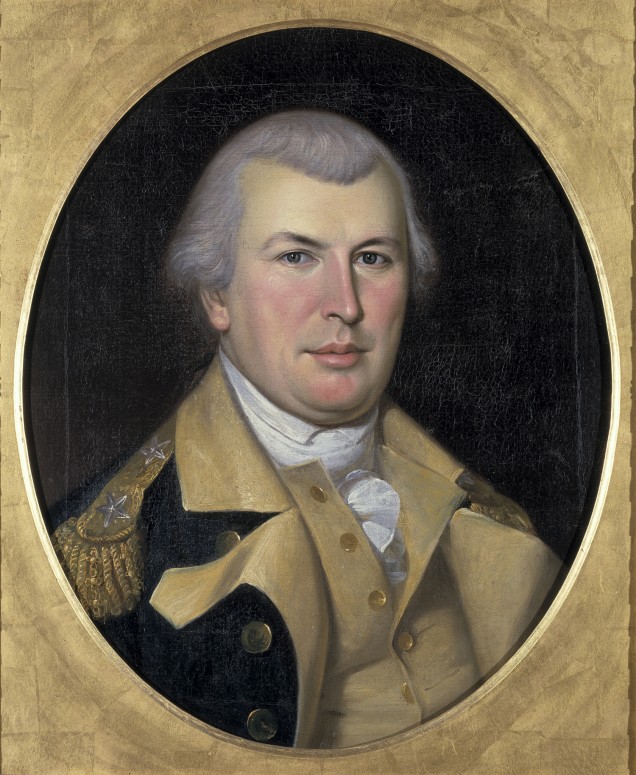
Independence National Historical Park; image courtesy of George Washington’s Mount Vernon
To have Lt. Col Washington’s horse kept in as good order as possible and let the militia Light horse do all the fatigue duty. We may want a body of heavy cavalry, and if they are broken down on common duty we shall have nothing to depend upon.[14]It was Washington’s belief that his dragoons should only use their sabers in battle. Washington subscribed to the European tactic that in order for heavy cavalry to be effective, they must move quickly and strike, thereby putting their firearms aside and relying on the sword in battle.[15] At Hobkirk’s Hill, Washington’s troopers were used in a flanking movement that did not materialize an outcome for which Washington would later on be scrutinized.
Engagement at Hobkirk’s Hill, 1781
By the April 17, 1781, General Nathanael Greene was established north of Camden. Greene’s command consisted of the following components: the left flank, under the command of Colonel Otho Holland Williams, John Gunby’s First Maryland Regiment consisting of two hundred men, Captain Robert Kirkwood’s Delaware light company consisting of forty men; and finally, the Second Maryland Regiment under the command of Lieutenant Colonel Benjamin Ford. The Right Flank Brigade was under the command of General Issac Huger and it consisted of Lieutenant Colonel Samuel Hawes’ First Virginia Regiment numbering two hundred men and Lieutenant Colonel Richard Campbell’s Second Virginia Regiment consisting of two hundred men. In addition, there were the following a Light Infantry company under the command of Captain John Smith, Lieutenant Colonel William Washington’s Continental Dragoons that numbered about ninety troopers, forty Continental artillerymen to include three six pounders under the command of Colonel Charles Harrison, and finally a reserve force consisting of two hundred and fifty four North Carolina militia. Colonel Frances Lord Rawdon’s command, it consisted of the following: Sixty Third Regiment of Foot numbering about one hundred and eighty men, the Irish volunteer contingent of one hundred and forty men, the New York Volunteers consisting of one hundred and sixty rank and file, King’s American Regiment consisting of one hundred and sixty men and a Corps of forty light infantry armed men. Major John Coffin commanded sixty mounted infantry (Dragoons). There were one hundred and thirty South Carolina Militia men, fifty Convalescents and a Royal Artillery detachment of twenty personnel and two six pounders.[16]
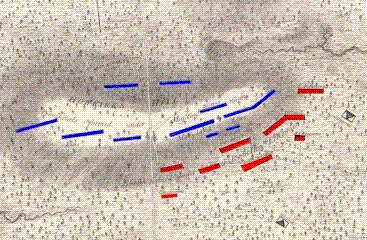
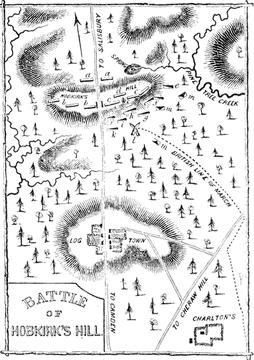
Greene camped his army on Hobkirk’s Hill one and a half miles north of Camden. Hobkirk’s Hill was a sandy ridge that stretched from east to west, with the eastern side anchored in a swamp near Pine Tree creek. On the western side, there was a heavily forested area which contained heavy undergrowth. There was a road from Camden to Waxhaw’s that ran from the North and began to rise in the middle of Hobkirk’s Hill. In front of Greene’s position was an open area, a plain covered by thickets. Not far from Hobkirk’s Hill sat a small group of cabins known as Logtown. Rawdon would approach Greene’s position along the Waxhaw’s road with its eastern side clear of heavy brush. Greene encamped his men in order of battle. Once Greene established his line of defense, he began to send out reconnaissance in order to detect Rawdon’s advance. With Marion pursuing Watson, Greene had to give up the idea of conducting a siege of Camden and therefore, would have to try to defeat Rawdon in open battle. Kirkwood’s Delaware light detachment was ordered to make a push towards Logtown. While Kirkwood was making his probe, Rawdon was concerned about the return of Watson and the possible fall of Fort Watson which would jeopardize the communications and supply line with Charleston. It was clear that Rawdon had to defeat Greene’s army on the field of battle or abandon Fort Watson and leave the interior for the coast. In terms of the strategic situation, if Rawdon moved to the coast, both the fortifications would fall to the Continentals. By April 24, Lord Rawdon received an intelligence report from a deserter in Greene’s column that supplies were lacking and that there wasn’t any artillery in Greene’s main line. Although the report was erroneous since Greene was moving his artillery to the front, Rawdon decided that the opportunity to take on Greene had presented itself.
Wikipedia
Greene’s men were tending to various camp duties on the morning of the 25th of April. At about 11:00 A. M., Greene heard shots from the picket line and Kirkwood deployed his light infantry towards the pickets in order to provide support. Kirkwood’s light corps along with the pickets, were putting up a defense and began to withdraw under fire while holding their line and giving “the enemy a warm reception.”[18] Greene indicated “The line was formed in an instant, General Hugers Brigade upon the right of the road, [Colonel] James Read with a few militia in the rear of the second line.” As Rawdon’s line advanced, the picket line under Captains Simon Morgan and Perry Benson, made a good account of themselves.[19] According to Colonel Gunby, the Crown forces were greeted with a “warm reception”[20] While the picket line was engaged, Greene was awaiting reinforcements of Colonel Thomas Sumter. However, unbeknownst to Rawdon’s Quartermaster Lieutenant Colonel Edward Carrington had arrived early that morning with provisions and the artillery. As Rawdon’s forces moved forward, they were now engaged with the First Virginia on the right and with the Second Virginia close to the road. East of the road the First Maryland was formed with the Second Maryland to the left. The troops were bare foot and partially cloth due to the fact that they had hurried to gather their weapons and fall into line. In reserve was Colonel William Washington as well as militia from North Carolina. Colonel Charles Harrison’s contingent of artillery placed two six pounders on the Waxhaw’s Road and the third piece was placed between First and Second Maryland Regiments. The pickets and Kirkwood’s Delaware lights were moving back through the brush and into a more open wooded area towards the bottom of the hill. Rawdon’s forces now moved out of the tree line, the Sixty Third Regiment was positioned on the right and the King’s American Regiment was stationed on the left. Harrison’s men viewed the target rich environment with the two Crown regiments moving forward along a narrow front and began to fire grapeshot at them thus driving the two leading regiments back into the tree line. Greene’s artillery devastated Rawdon’s advance, giving Greene a sense of false optimism that the battle was in his hands. Greene was unaware of the remainder of Rawdon’s forces.[21]
As the enemy were found to be advancing only with a small front, Lieu Col Ford with the 2nd Maryland Regiment had orders to advance and flank them upon the left, Lieut Col Campbell had orders to do the like upon the right. Col Gunby with the first Maryland Regiments, and Lieutenant Col Haws with the second Virginia Regiment, had orders to advance down the Hill and charge them in the rear. The whole line was soon engaged in close firing, and the Artillery under Col [Charles] Harrison playing on their front.[22]Rawdon’s was astonished by the sight of Greene’s artillery for intelligence suggested that Greene did not have any ordinance. The First Maryland and Second Virginia began their advance with bayonets pointed forward. The left regiment made up of the Second Maryland and the right regiment, the First Virginia were on the flanks and began their assault down the hill towards Rawdon’s command. To complete the assault, Lieutenant Colonel William Washington “had orders to turn the Enemies right flank and charge them in the rear.”[23] According to Lieutenant – Colonel Light Horse Harry Lee
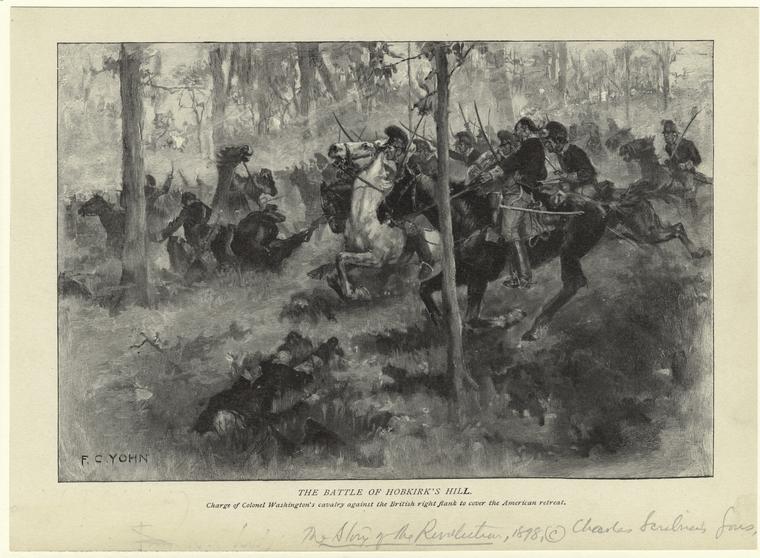
the battle opened up from right to left with vigor which promised a keen and sanguinary contest; but the superiority of our fire, augmented by that from our well-served artillery, must have borne down all opposition, had the American line maintained itself with becoming firmness.[24]As elements of Greene’s forces advanced, Rawdon gave the order to widen his front and had his reserve force brought forward. As Greene’s men moved forward, they prevented the artillery from continuing to do its job. Due to the slowdown of the artillery fire, Rawdon’s forces reformed and began to lay down fire along Greene’s front. The Volunteers from Ireland began to lay down fire with the Second Maryland bearing the brunt of the musketry.[25] The Crown forces found themselves moving through thick cover throughout sections of the hill and began to pour a heavy fire on the advancing Americans. Colonel Washington’s light dragoons began to move around Rawdon’s right.
F. C. Yohn, The Story of the Revolution (1898); New York Public Library
Wikipedia
While Washington was dealing with his prisoners, Colonel John Gunby’s First Marylanders were continuing their advance towards the opposing side. With their bayonets pointing forward, the Marylanders advanced until “Captain William Beaty of the Maryland Line, a most excellent officer and an ornament of his profession,”[28] was killed. Beaty was commanding the two flank companies on the right. There was confusion as the two flank companies on the right stopped their advance and the remainder of the regiment pressed on. Lieutenant – Colonel John Gunby decided to dress ranks by stopping the line and bring the center companies into line. “Colonel Gunby, with view of bringing the regiment to range with its colors, ordered it to fall back to the right company.”[29] As the First Maryland tried to get itself reestablished, Rawdon’s line charged the Marylanders who broke and began to fall back in disorder. According to Rawdon’s report
I had ordered [Lieutenant] Colonel [Archibald] Campbell to lead the attack with the 63rd and King’s American Regiments, which he performed with great spirit. . . The three corps [along with the Volunteers of Ireland] quickly gained the summit of the hill, and giving room for the rest of our force to act, the rout of the enemy was immediately decided.[30]Lieutenant Colonel Benjamin Ford commanding the Second Maryland received a musket ball to the elbow. With the wounding of their officer and the flight of the First Maryland, the Second Maryland now did the same, fleeing the field. Along with the Second Maryland, the First Virginia, part of Hugers Brigade on the far right, turned tail and ran. Officers were trying to hold the front line and salvage what was left of the command. Nevertheless, the entire front line collapsed and began to move back up Hobkirk’s Hill. Colonel Otho Williams stated “the best disciplined troops have been enervated and made cowards by it.”[31] The Continentals were now being pressed by the advancing British. Greene, startled at what he saw, ordered the artillery to be limbered in order to save the guns. As the guns were being saved, Lieutenant – Colonel Gunby tried to reorganize a defense with the First Maryland however, it proved to be too late. “Rawdon’s right now gained the summit of the eminence, flanking Hawe’s regiment [Second Virginia], which had undeviatingly held it’s prescribed.”[32] The Second Virginia were now the only ones on Greene’s line that could try to stem the tide of the onslaught. Growing concerned that the Second Virginia would be out-flanked and possibly destroyed, Greene ordered them to retreat from the field. At this point in the battle, Greene noticed that the limbers carrying the field artillery was caught in the underbrush and had to be cut away. Greene did not want to lose his artillery and made an endeavor to assist in hauling the field pieces off the field. Green ordered the Second Virginia to cover the retreat so that it did not become a total rout. The company of Maryland Light Infantry commanded by Captain John Smith, assisted in hauling the field pieces down the Waxhaw’s road with all possible speed. Unbeknown to Greene, Major Coffin’s Dragoons had reformed, were back in the saddle, and made a charge towards the field pieces. The Maryland Light Infantry that was assisting with the withdrawal of the guns, tried to check the Dragoons who were advancing toward them. “‘The Maryland Brigade was in part rallied, but Lord Rawdon had gained the hill, and it was thought too late to retrieve the fortunes of the day.”’[33] Nevertheless, Coffin’s men reformed and with the arrival of additional forces, laid down fire upon the retreating Continentals. The battle now became a running fight down the Waxhaw’s road, nevertheless, the Maryland Light Infantry, provided critical time that allowed the field pieces to be moved to safety. Unfortunately, the Second Virginia, found itself in a melee with Coffins dragoons while covering the retreat and was decimated. Captain John Smith found himself now the prisoner of the Crown forces.[34]
Coffin’s New York Dragoons were moving toward the guns while Greene’s men tried to bring them to safety. While doing so, approximately fifty men were killed around the field pieces prior to the arrival of Washington’s Dragoons. Historians have criticized Washington’s wide movement into Logtown in lieu of moving against the rear of Rawdon’s command. Greene was able to move his troops in good order away from the field of battle. Like Cornwallis at Guilford Courthouse, Rawdon was unable to decimate Greene’s army which would remain active in the field.[35]
Greene’s casualties consisted of one hundred and eight wounded and twenty five killed which included seven officers, one hundred and eight wounded and one hundred and thirty six missing. Rawdon’s casualties consisted of thirty nine killed. Greene was disappointed by some of his subordinates, like Thomas Sumter who never arrived with reinforcements. Also, Greene blamed Gunby who had ordered a retreat which was in Greene’s view unnecessary. However, Lieutenant – Colonel Lee had a different view of the situation.
Colonel Gunby, with a view of bringing the regiment to range with its colors, ordered it to fall back to the right of the company; but Morgan had given the same order, at the Cowpens, to the corps of Howard, which was not only executed with promptitude, but was followed by its decisive advance, and consequent signal success.[36]The American retreat from Hobkirk’s Hill was not long lived. The troops of the Crown forces left in the vicinity of Hobkirk’s Hill were a company of dragoons. Greene redeployed Washington and Kirkwood’s Delaware regiment who successfully drove the dragoons off the field. Greene’s army now occupied Hobkirk’s Hill for a second time. Greene gave the order to soon to advance his line when he ordered a bayonet charge. Once the infantry advanced, the artillery was no longer able to play a part in the engagement. With the halt to artillery fire, Lord Rawdon was able to reorganize and bring his infantry to bare against Greene’s advancing line. Colonel Washington became bogged down with prisoners following his circuit around Rawdon rear. Perhaps if he had continued his charge on Coffin’s Dragoons, he could have made more of an impact on the engagement. In an essay prepared by Lee F. McGee, entitled “European Influences on Continental Cavalry”, he states,
detaching cavalry in a wide circuit around the enemy flank to gain the rear was an accepted tactic in the Prussian Cavalry. Closer analysis has revealed that Washington did in fact encounter combatants, and, as at Cowpens, disrupted the British rear.[37]According to historian Matthew Spring,
similar to “the battles of Freeman’s Farm, Bemis Heights, and Hobkirk’s Hill were comparable to that at Bunker Hill. In each case the rebels foiled British attempts to turn their positions and instead embroiled the King’s troops in sustained and costly close combats in which numbers and / or position told heavily against them.[38]Despite being victorious, Rawdon’s losses could not be replaced and placed him in a precarious situation.
By May 7th, Rawdon was joined by Colonel Watson. However it was futile. For despite the victory Rawdon pulled out of Camden following the arrival of Lee and Colonel Francis Marion’s forces. Rawdon realized that his supplies were running low and his communications with Charleston were cut. “‘Rawdon evacuated Camden yesterday afternoon,” and added in a facetious way, has left Capt. Jack Smith commandant of this place, in the care of his sick and wounded, as well as ours.”’[39] With Greene occupying the battlefield and Lee and Marion’s partisan forces lurking about, On May 9th, Rawdon decided to move out from Camden and retreat to Monck’s Corner which was about thirty miles from Charleston. Rawdon sent a dispatch to Colonel John Cruger who was in command of the garrison at Ninety Six. Rawdon instructed Cruger to abandon his post at Ninety Six and move to support the British garrison at Augusta.[40] By late August, the British fortifications in the interior were no-longer operational.
| * * * |
Show Notes
| * * * |
About the author:
John Pezzola is a veteran of the United States Army. He currently teaches 7th-grade U.S. History and is an Assistant Professor of Military History at American Military University.
* Views expressed by contributors are their own and do not necessarily represent those of MilitaryHistoryOnline.com.