Sibi Totique (for himself and for all): The Birth of Benedict Arnold's Treason: A Study in Leadership
By Gerald J. KriegerBenedict Arnold was a complex and contradictory figure. He was a brilliant military commander who made major contributions to the American cause, but he was also deeply flawed and ultimately betrayed his country. Arnold's life and career offer many lessons. One lesson is that power and ambition might corrupt even the most talented and dedicated individuals. Another lesson is to be vigilant against those who would betray their country for personal gain.
Despite his flaws, Arnold's story reminds us that the American Revolution demanded great sacrifice and heroism. His early heroics with the Continental Army were essential to the American victory, and his capture of Fort Ticonderoga was a major turning point in the war.
Arnold was a daring and resourceful commander who regularly led his troops into the most dangerous situations. He was also a skilled tactician and strategist who could outwit his British opponents. However, Arnold's character flaws ultimately led to his downfall. He was arrogant and ambitious, often putting his glory above the cause's needs. He also resented political leaders and quickly blamed others for his failures.
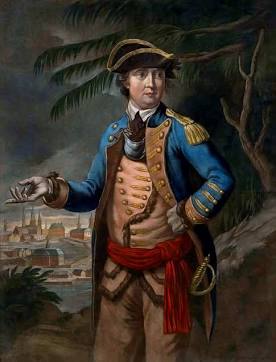
Mezzotint published by Thomas Hart (London, 1776). Depicting Arnold as a military commander early in the Revolutionary War. Courtesy of the National Portrait Gallery / Wikimedia Commons (Public Domain). Many historians suggest this was a generic portrait and did not resemble Arnold because of the weakened chin.
This article explores events leading to Arnold's treason, which began in Philadelphia. Events in the city spun out of control, creating fierce resentment toward civil authorities and breeding a sense of bad faith in Arnold. He also felt that his staunchest supporter, General George Washington, betrayed him. Arnold's frustrations with civilian authorities and his perceived lack of support from Washington drove him to abandon the American cause. The discussion has two parts. The first establishes a basis for Arnold's character in Philadelphia. The second part analyzes Benedict Arnold, drawing on several contemporary studies of him, and what present military leaders can learn from his experiences, including the importance of leader-subordinate relations within civilian-military cooperation.
Arnold's early career is well known. He was one of the Army's most capable Continental officers. During the Battles of Saratoga (September 19 and October 7, 1777), Arnold received his second combat wound to his left leg during the campaign. His injury prevented him from taking a field command, so Washington appointed him military governor of Philadelphia. Washington's instructions to Arnold were simple: ensure law and order and guarantee that former loyalists to the British Crown faced no harassment. Washington knew the environment was precarious and that pro-independence colonists were eager to exact revenge for their former persecution under British authorities.
Once the British evacuated Philadelphia on June 18, 1778, Arnold entered the city the following day, on the 19th, to assume his role over what is now eastern Pennsylvania and southern New Jersey. Administratively, the Pennsylvania Supreme Executive Council ran the city, and its president served as governor. Philadelphia was the largest city in the thirteen colonies. Large groups of neutral Quakers, along with many Patriots, lived there, though many Tories also remained in the city. Many residents simply waited to see how the war would end before deciding their loyalty. Naturally, even slight murmurs of support for King George III provoked strong community responses. Noted historian Willard Sterne Randall captures well the situation that Arnold entered:
A struggle for control of the nation's capital involving the radical new revolutionary government of Pennsylvania, the anti-Washington, anti-Schuyler, and anti-army factions in the Continental Congress, and the Army, which was to be represented only by Major General Benedict Arnold.[1]
Unfortunately for Arnold, being close to Washington, Schuyler, and an essential military representative of the Continental Army was three strikes too many. The only groups that were mildly receptive to him, or at least not outright contemptuous, were the Quakers and former Loyalists. Washington commanded Arnold to retain the city's skilled tradesmen. He felt their skills were practical to support the military.
Reports said Philadelphia Tory merchants began hiding goods for public consumption and selling them to the Army at much higher, inflated prices. This news prompted Congress to suspend all trade, which, in turn, made the public hostile. Joseph Reed, who was elected president of the council on December 1, 1778, directed a committee to compile names of Tory sympathizers for prosecution and punishment. Arnold blocked all acts of retribution. Arnold's action earned him rebuke from most of the city, who sought to punish the Tories.[2]
During a 4th of July celebration (1778) commemorating the Declaration of Independence, Arnold met and instantly fell in love with eighteen-year-old Peggy Shippen. Arnold was thirty-seven at the time. Her father was a judge and belonged to one of Philadelphia's most prominent Loyalist families. Arnold courted her and convinced her father that he possessed enough wealth to support a family.
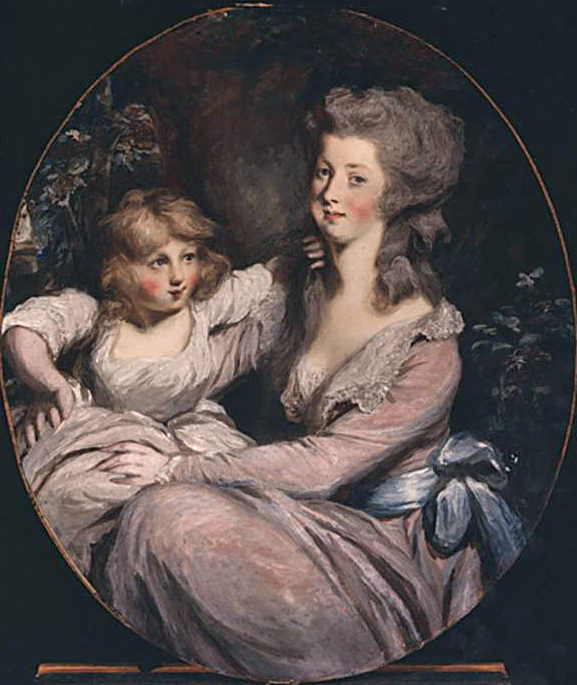
Portrait by Daniel Gardner (c. 1780s), showing Peggy Shippen, whose prominent Loyalist family connections and social ties in Philadelphia played a central role during Arnold's tenure in the city. Courtesy of the Philadelphia Museum of Art / Wikimedia Commons (Public Domain).
In 1778, Arnold liberally issued passes allowing people to enter and leave Philadelphia to conduct business. A businessman named Robert Shewell told Arnold he was transporting his ill wife and personal property. He also said he was selling goods to the Continental Army. Arnold readily signed a pass for Shewell, allowing him to enter any American port. Shewell's ship, the Charming Nancy, was involved in the lucrative Canadian smuggling business where prices were higher, unbeknownst to Arnold. On the Delaware River, an American privateer, Samuel Ingersoll, stopped the Charming Nancy, forcing the ship into Egg Harbor, New Jersey, the closest American port to New York City.[3] Here the local sheriff, Bowes Reed, Joseph Reed's brother, became involved, though it was to sit idle for a period due to British raids in the area. The pass suggested Arnold's involvement in the smuggling operation. Joseph Reed quickly learned of the incident and added it to his running list of Arnold's transgressions in the city.
Within a month of his tenure in Philadelphia, Arnold painfully realized his personality and skill set did not suit a military governor's role. He knew his meager military salary was acceptable during campaigns but far too low to resume his comfortable lifestyle. Meanwhile, he needed to earn enough income to support himself and convince Judge Shippen that he had the means to keep his interest in the Judge's daughter. Arnold wrote Washington on July 19, 1778, and requested command in the Navy. He said he had neglected his private affairs since joining the Army. Arnold wanted to retire to public business or accept an offer "to the command of the Navy to which [his] being wounded would not be so great an objection, as it would remaining in the Army. I must beg leave to request for Excellency's sentiments respecting a commanding in the Navy," he continued, searching for a way out of the toxic Philadelphia political scene and into a more lucrative position.[4] Washington responded on August 8, wishing him well, though he professed ignorance of maritime affairs. He stressed a desire for Arnold to resume command under him. A few years later, during the summer of 1780, Congress transferred the few remaining naval frigates under Washington's control.[5]
Arnold had many disputes with members of the Pennsylvania Council; several of them made it into the local newspapers. The situation in the city was heating up. On January 21, 1779, the Pennsylvania Council wrote to Arnold and requested details about military wagons used for personal business. The board also asked Congress to investigate Arnold, though it provided no charges or details.[6] Arnold learned of these charges on February 6th, while meeting with Washington, who advised him to request a court-martial. Ultimately, Reed and his committee formed eight charges and printed them in the local paper. He also sent copies to Washington and to representatives of all states.[7] Here is a summary of the charges:
- Issuing a pass to a known smuggler (Charming Nancy)
- Closing the city shops while making private purchases and sales
- Forcing militia to do menial jobs (one of his aides used a militia sergeant to get a barber)
- Interfering with a Pennsylvania court ruling on profiteers
- Using government wagons for personal business
- Issuing passes without signatures from the Pennsylvania committee
- Failure to report his use of government wagons for personal use
- Supporting loyalists rather than patriots.[8]
These charges in February unnerved Arnold. They also greatly concerned Peggy's father (Arnold married Peggy in April). He loved Peggy deeply. The charges also damaged his public reputation.
On March 17, 1779, Arnold wrote to John Jay, the President of Congress. He requested a speedy investigation to clear his name. Arnold knew he had to leave Philadelphia. He relinquished his command to Brigadier General James Hogan on March 19, 1779, though he remained in the city. He wrote to Washington, requesting an appointment outside Philadelphia. On April 3, Arnold learned that Congress determined only four of the charges (1, 2, 3, and 5) were potentially viable for a court-martial. They set a trial date of May 1, 1779, without Arnold's knowledge. He was busy with wedding preparations, which would occur on April 8, 1779, at the Shippen residence in Philadelphia.
On April 18, 1779, Arnold wrote again to Washington about Reed's wild accusations, requesting a speedy trial, mere weeks after the wedding. He worried Reed would delay the trial to gather evidence.[9] Washington responded two days later, apprising Arnold of the May 1st date. Reed wrote to Washington on April 24th, arguing that he never intended to raise all the charges. The only substantial evidence, Reed claimed, was of Arnold's personal use of government wagons. He and the rest of his committee needed more time. Reed also suggested that he would block the use of wagons by the military if he were not afforded adequate time to prepare for the court-martial.[10] Reed sent a similar letter to Congress requesting a delay, and, surprisingly, threatened that Pennsylvania would secede if pressed on the issue.[11] Washington reluctantly wrote to Arnold on April 28, advising him that the court-martial witnesses were in Virginia and Carolina. The trial had to be postponed until early July. This letter sent Arnold over the edge. His May 5, 1779, response revealed his frustration and painted him as nearly hysterical. He wrote:
From a candid view of the charges and the whole proceedings against me…you must be fully persuaded that I have been unjustly accused and that I have been refused justice from Congress on the report of their committee. . . If your Excellency thinks me a criminal, for Heaven's sake let me be immediately tried, and if found guilty, executed. . . Having made every sacrifice of fortune and blood and become a cripple in the service of my country, I little expect to meet the ungrateful returns I have received from my countrymen. Still, as Congress has stamped ingratitude as a current coin, I must take it. I have nothing left but the little reputation I have gained in the Army. Delay in the present case is worse than death.[12]
Washington read Arnold's letter and replied two days later. He told Arnold the new trial date would be on June 7th. Reading the passage above, almost two hundred and fifty years later, Arnold's anguished words provide the best backdrop of a man trapped by fate, backed into a corner, grasping for a lifeline. The new trial date was almost a month away. It did little to ease Arnold's concerns. The "rescue" came not from Washington, but from a friend who had previously been very close to Washington.
Not long after Arnold learned of his new trial date, a British parolee stopped by to deliver a lengthy letter from Washington's former intimate friend, loyalist Colonel Beverly Robinson.[13] Dated May 1779, the letter urged Arnold to abandon his cause and enter the ranks of the American loyalists. No evidence shows Arnold replied. Years later, Joseph Stansbury, a young Philadelphia merchant who was widely known to be uncommitted to any cause, wrote that he met with Arnold in the middle of June 1779. Stansbury said the two discussed ways to end the war (many historians believe the meeting took place in May).[14] Near the end of their long discussion, Arnold swore Stansbury to secrecy, telling him that he was debating two options: to offer his services to General Sir Henry Clinton or to join the British Army.[15]
Arnold was a determined man. Once he decided on a task, he remained attached to its success or failure. Arnold demonstrated this characteristic in his march to Quebec and the Battle of Valcour Island three years earlier. When he met Stansbury, Arnold had already written to a prominent New York figure to offer his services to the British. The letter was lost, but he must have written it sometime in April 1779.
Arnold's court-martial was rescheduled several times because of British threats in the area and other excuses from Reed. It finally took place on December 19, 1779, in Morristown, New Jersey. The trial was lengthy, and the court rendered judgment on January 26, 1780. The court acquitted Arnold on two charges but found that he had issued "irregular" passes and was also guilty of improperly using government wagons. General Washington was to render the reprimand, though he did not do so immediately. Months later, on April 6, 1780, Washington reluctantly issued a gentle rebuke of Arnold. Nothing could have altered Arnold's mind by this time. He continued his coded correspondence with Major John André, Clinton's adjutant-general for the Army in America. Arnold assumed command of West Point on August 3, 1780. Washington was to meet Arnold for breakfast on September 25, 1780. Arnold fled to the British that same morning, shortly after learning of André's capture and the details of his plot to deliver West Point to the British.
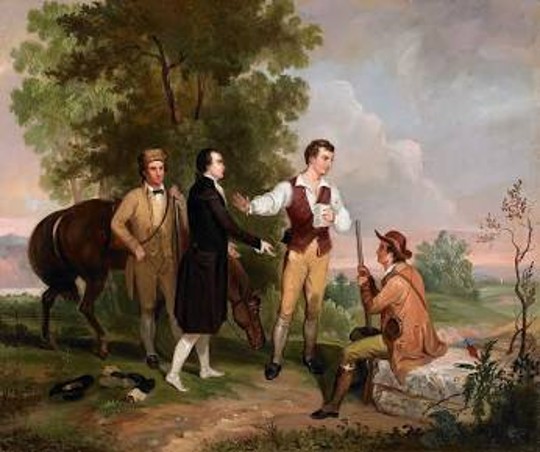
Painted by Asher Brown Durand (1845). Depicting the interception of British Adjutant-General Major John André by American militiamen in September 1780, revealing Arnold's plot to surrender West Point. Courtesy of the Birmingham Museum of Art / Wikimedia Commons (Public Domain).
Arnold began to contemplate working with the British in April and May 1779. In a May 28, 1780 letter, Washington expressed frustration with Congress's failure to fully support his Army. He wrote, "Unless a system very different from that which has long prevailed be immediately adopted throughout the States, our affairs must soon become desperate, beyond the possibility of recovery. . . Indeed, I have almost ceased to hope."[16] However, when Arnold decided to defect in 1779, the situation had improved for the American Army. The French recognized the United States, signed the Treaty of Alliance on February 6, 1778, and actively supported the Continental Army. With France in the war, the Continental cause gained momentum, at least by May 1779. Arnold did not write anything to this effect at the time. Instead, he wrote about his frustration with Congress and Reed, as well as his tarnished reputation.
Arnold's descendants tell a story about Arnold's meeting with Beverly Robinson shortly after arriving at West Point. After Arnold's defection, an unsigned letter attributed to Robinson was found at West Point. It reflected many of his earlier statements, urging Arnold to defect to save lives and America.[17] Arnold may have wavered in turning traitor; Robinson assured him that his cause was just.[18] The biographer Isaac Arnold captured Benedict Arnold's quandary, writing:
For conceding all, admitting that his passions so misled his judgment as to make him believe that he could by betraying his post benefit his country, this is no excuse for his treachery; if honesty satisfied that the war should be no further prosecuted, he should have resigned and left his comrades—not sought to betray them.[19]
Immediately after joining the British, Arnold published a letter in the Royal Gazette on October 11, 1780. His letter, entitled "To the inhabitants of America," was followed by another, "To the Officers and Soldiers of the Continental Army who have the real Interest of their Country at Heart, and who are determined to be no longer the Tools and Dupes of Congress, or of France" (October 20, 1780). In both letters, Arnold argued that he changed sides because America's greatest enemies are within its borders. Both the public and Continental soldiers and officers generally read his words with disdain. Although many soldiers were upset with their conditions in the poorly supplied Army, they rebuked British agents and refused to betray their cause. Both of Arnold’s letters were heavily influenced by William Smith, the loyalist Chief Justice of New York (1780-1782), a renowned orator and historian.[20]
Arnold’s timing has much to do with his frustration rather than the growing friction within Washington’s Army. The Continental cause reached its nadir in January and February 1781 with the infamous Pennsylvania Line Mutiny (January 1-8, 1781). The 2,400 men, frustrated with poor living conditions and lack of pay, became violent and unruly, threatening to march against the Continental Congress. Only 1,150 of the men remained to serve, while the rest ultimately returned home. But by then, Arnold was already serving as a British officer. Some historians suggest that even as Arnold learned of the verdict (January 1780), he was only guilty of listening to or considering defection. This observation was incorrect. On May 23, 1779, Arnold wrote a cipher letter and reported troops and supplies in Charleston, South Carolina, to the British. [21] The British were planning a potential invasion of Charleston that would not take place until March 29-May 12, 1780. Brumwell's claim that Arnold defected to the British because he knew that the American cause was lost is not supportable. All of Arnold's correspondence dates from after his time as a British officer.
Benedict Arnold was perhaps the most talented field commander for either side during the American Revolution. His reckless bravado was the driving force behind numerous actions, most aptly demonstrated during the Battle of Quebec (December 31, 1775), the Battle of Valcour Island (October 11-13, 1776), the Battle of Ridgefield (April 27, 1777), and the Battles of Saratoga (September 19 and October 7, 1777). Arnold resigned before Saratoga because he was frustrated by seniority issues exacerbated by Congress's actions. Washington understood the unique situation in Philadelphia, particularly the tensions between Loyalists and Patriots. Still, Washington's inability to give Arnold a way out of his predicament may have contributed to Arnold's betrayal. Leaders must understand their subordinates and watch for the point at which they break. Success on the complex (and often urban) modern battlefields requires effective decision-making and execution.
Conclusion
Benedict Arnold’s treason grew out of personal ambition, political conflict, and a prolonged sense of grievance. He was one of the most capable officers in the Continental Army, but he lacked the skills vital to navigate Philadelphia’s complicated political arena. Arnold's frustrations with civilian authorities and his perceived lack of support from Washington drove him to abandon the American cause. Some historians suggest that the idea that Arnold hoped to staunch American bleeding and bring the inevitable loss to an early conclusion does not hold water. His letters show his intense frustration with Joseph Reed, the Philadelphia Supreme Executive Council, and Washington’s lackluster support. Unwittingly, Washington gifted Arnold a poisoned chalice when he placed him in charge of Philadelphia. Historian John Ferling wrote that he did not incline to defect to the British before his assignment in Philadelphia.[22] Arnold assumed a role for which he lacked the temperament, political skill, and emotional acumen needed to succeed. Isaac Arnold expressed the essence of the fall of Benedict Arnold well:
He had listened to the tempter, and to hesitate and deliberate over a crime so desperate, was to fall. Like a rudderless ship in the violence of a wild ocean tempest, uncontrolled by principle, he was drifting hither and thither, wherever the storm of passion might carry him.[23]
Had Congress granted Arnold a commission in the Navy, Benedict Arnold's name may well have been synonymous with that of victory against impossible odds. Alas, fortune did not favor the bold Arnold. Glory and pride were the twin gods that inspired Arnold's quest for fame. His fate was sealed the moment that his carriage entered the city of Philadelphia.
| * * * |
Show Notes
| * * * |
About the author:
Gerald Krieger, COL (ret), has published articles on military history, US policy, and international relations. He has a doctorate from Salve Regina University. A graduate of the US Army War College, he also has graduate degrees from San Jose State University and American Military University.
* Views expressed by contributors are their own and do not necessarily represent those of MilitaryHistoryOnline.com.